Artificial trees · Ficus
Artificial ficus trees for composed interiors.
From compact green ficus to architectural fiddle-leaf forms, explore realistic artificial trees selected for homes, furnished rentals, offices and hospitality spaces.
-
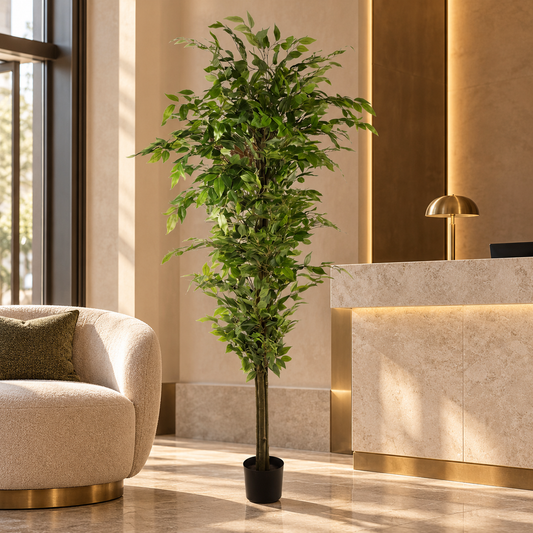
180cm Artificial Ficus Tree Green
Regular price £93.99 GBPRegular price

The Ficus guide
Choose greenery that fits the room and the brief.
A practical guide to selecting, styling and caring for artificial ficus trees in residential and commercial interiors.

How to choose an artificial ficus tree
An artificial ficus works best when its height, canopy and planter feel proportionate to the room. Start with the place the tree needs to occupy rather than choosing from height alone. A narrow reception corner may need a taller tree with a controlled footprint, while a broad lounge or open-plan workspace can carry a fuller, bushier silhouette. Measure the available floor area, the height beneath lights or shelving, and the sightline from the main entrance. The aim is to add a soft botanical layer without making circulation feel tight.
Ficus is a useful family for interiors because the shapes range from small-leaf, densely branched trees to the larger sculptural leaves associated with fiddle-leaf fig. Traditional green ficus gives a quiet, familiar canopy. Variegated foliage introduces lighter edges and can lift a darker room. Fiddle-leaf forms have fewer, broader leaves and read as a more architectural statement. Twisted or natural-style trunks bring extra texture, particularly in hospitality and furnished accommodation where the tree may be viewed from several angles.
Check every product page for the published height, supplied pot and intended placement. Dimensions refer to the product as supplied, and foliage may need gentle dressing after unpacking. Decorative planters shown in styled photography are not included unless the product description explicitly says so. Where an exact footprint matters, contact Grove & Form before ordering and we will confirm the available verified measurements.
Ficus foliage styles and the rooms they suit
Small-leaf ficus creates a layered canopy with plenty of fine detail. It is a dependable choice when the tree will be seen close up, such as beside a reception desk, in a waiting area or near a living-room chair. Dense green foliage adds depth against pale walls, while a more open branch structure can sit comfortably in a smaller room because some of the background remains visible through the leaves.
Variegated ficus has lighter markings around or across the leaf. That contrast can help the foliage remain legible in an interior with dark joinery, shaded corners or richly coloured walls. It also makes a stronger visual statement, so use it deliberately. If a project already contains patterned upholstery, artwork and several finishes, a plain green tree may give the scheme a calmer result.
Fiddle-leaf fig, often listed as ficus lyrata, has broader leaves and a more graphic silhouette. It works particularly well with simple furniture, generous wall space and modern architectural materials. Because the leaves are larger, dust and edge condition are more visible at close range; regular light cleaning is worthwhile in guest-facing rooms. A fiddle-leaf form can feel substantial without the fine visual density of a bushy traditional ficus.
Trunk character matters too. Straight multi-trunk trees feel clean and adaptable. Twisted or braided-style trunks introduce a decorative element before the canopy begins, while natural-wood trunks can bring more variation. Review the actual product photographs from several angles. Lifestyle images show context, but the plain supplier views remain the clearest reference for the item you will receive.
Choosing the right height and visual scale
Up to 90cm: desks, shelves and layered displays
Compact ficus plants and bonsai-style forms suit console tables, reception counters, shelving and smaller apartments. They work well where a floor-standing tree would interrupt movement or compete with furniture. In a commercial setting, use them to soften a waiting table, meeting-room credenza or guest-room desk. Allow breathing room around the foliage so the plant reads as an intentional object rather than an accessory squeezed into a gap.
90–130cm: flexible floor-standing greenery
This middle range is easy to place beside armchairs, low cabinets and bedroom furniture. It can add height without dominating standard ceiling heights. A 120cm tree can also work in groups: two related forms can frame a wide console, mark a transition between zones or repeat a visual rhythm along a corridor. For furnished rentals, mid-height trees are often easier to move between rooms when layouts change.
140–180cm: entrances, lobbies and open spaces
Taller ficus trees are designed to be read from across a room. They can anchor a hotel lobby seating group, fill a quiet office corner, soften the end of a corridor or add presence to a large living room. Check ceiling features, pendant lights and door swings before ordering. In high-traffic locations, position the planter outside the main walking line and consider a heavier decorative planter for stability. A larger outer planter also gives a tall tree the visual weight it needs at floor level.
Artificial ficus trees for hospitality, offices and furnished rentals
Commercial interiors need greenery that continues to look composed through changing seasons and busy operating hours. Artificial ficus can provide that consistency without a watering rota, leaf drop or dependency on natural light. It is especially useful in internal reception areas, meeting rooms and guest spaces where live plants may struggle. The benefit is visual reliability, not an excuse to ignore placement: foliage still needs dusting, occasional reshaping and protection from repeated knocks.
Hotels, restaurants and hospitality
Use taller trees to define seating zones, soften hard architectural edges and create a calmer arrival. A pair can bring balance to a wide entrance, while a single asymmetric tree feels more relaxed beside a lounge chair or host station. Keep emergency routes, signage and service paths completely clear. Where fire performance is a project requirement, select only products whose individual listing explicitly confirms the relevant fire-retardant specification; do not assume the whole collection shares the same treatment.
Offices and client-facing workplaces
In a workplace, ficus can reduce the visual severity of screens, storage and glazed meeting rooms. A restrained green canopy works well behind reception seating or at the end of a bank of desks. Repeat one or two sizes rather than mixing every available leaf type: a small family of coordinated forms creates a more considered scheme and simplifies replacement or expansion later.
For project planning, think in zones. Arrival spaces may need one taller focal tree; collaboration areas can use mid-height forms to soften furniture groups; private offices may only need a compact plant on a low cabinet. Photograph each proposed location and record the maximum height and footprint. This small schedule makes it much easier to select products consistently and avoids treating every room as a separate styling exercise.
Short-let and furnished accommodation
A well-scaled artificial tree helps a furnished property photograph consistently and remain presentable between stays. Place it where it adds depth to the main room photograph without obscuring windows or making the space feel smaller. Choose a stable location away from suitcase paths, radiators and doors. For multi-unit schemes, record the product SKU and room placement so the same look can be repeated across apartments.
Styling a ficus so it looks intentional
The supplied nursery pot is usually functional and deliberately compact. An outer planter gives the tree a finished relationship with the room. As a rule, broader canopies can support a more substantial planter, while slim trees benefit from a quieter cylindrical or softly tapered form. Neutral stone, warm clay, dark metal and textured fibre finishes all work; choose one that connects to nearby flooring or furniture rather than trying to match the leaves.
After unpacking, work from the trunk outward. Open branches gradually, vary the direction of leaf clusters and preserve some natural gaps so light can pass through the canopy. Avoid pulling every stem into a perfectly symmetrical outline. View the tree from the room's main approach, then make small adjustments. If the back will face a wall, concentrate the best depth and branch movement toward the visible angles.
Artificial greenery looks strongest when it is part of a material story. Pair ficus with timber, stone, linen, plaster and softly reflective metals. In hospitality, the tree can connect a seating area to a garden view or botanical artwork. In an office, it can soften acoustic panels and neutral upholstery. In a home or short-let, it can add height beside low furniture and make an empty corner feel furnished without adding another hard-edged object.
Leave some negative space around the canopy. A tree pushed directly between tall furniture can look compressed even when its dimensions technically fit. As a practical starting point, mark the expected pot position with tape, then step back to the normal viewing point. Check doors, cleaning access, sockets, curtains and the path used to move luggage or service equipment. The most convincing placement is usually one where the tree has a clear purpose and does not need to be moved every day.
Before you order: a practical checklist
Confirm the product height, number of items in the pack, indoor or outdoor suitability, supplied pot and any verified fire-performance information on the individual listing. Measure the route into the room as well as the final position. Although artificial trees can often be dressed after unpacking, large cartons still need to pass through doors, lifts and corridors. For a multi-site or multi-room order, keep a simple schedule with the product name, SKU, quantity, room and delivery address.
Price should be compared against the complete specification, not height alone. A product supplied with a decorative planter is different from a tree in a nursery pot; a fire-retardant or UV-resistant model has a different intended use from a standard indoor tree; and a fuller canopy can create more presence than a taller but narrower form. Grove & Form product pages separate these facts so the comparison is clearer.
When the order arrives, inspect the carton and product before disposing of the packaging. Check the trunk, foliage, pot and included components against the listing. Photograph any transit concern promptly. Once the tree is positioned, allow time for careful branch dressing before assessing the final silhouette. For project orders, style one unit first and use it as the reference for the remaining rooms.
Simple care for artificial ficus foliage
Dust is the main reason artificial foliage loses its depth. Use a soft, dry microfibre cloth or a gentle duster, supporting larger leaves as you clean them. Start at the top so displaced dust does not settle on finished areas. For detailed canopies, a cool, low-powered airflow can help, but avoid harsh compressed air at close range. Do not use aggressive household chemicals, polish or abrasive cloths unless the individual product instructions explicitly permit them.
Review high-traffic trees during routine room checks. Re-open compressed branches, turn the planter if one side is repeatedly brushed, and make sure the tree remains stable. Indoor products should not be moved outside unless the listing specifically states that they are suitable for outdoor exposure or UV resistant. Colour performance, construction and finishes vary by product, so the individual description remains the source of truth.
Artificial ficus tree questions
Do artificial ficus trees arrive fully shaped?
They are packed for transport, so branches and leaves normally need gentle dressing after unpacking. Shape the canopy gradually and use the product photographs as a reference.
Is the decorative planter included?
Only when the product title or description explicitly says that a decorative planter is included. Many trees arrive in a practical weighted nursery pot ready to place inside an outer planter.
Can I use an artificial ficus outdoors?
Only choose outdoor placement when the individual listing confirms outdoor or UV-resistant suitability. Standard indoor artificial trees should be kept inside.
Which size works best beside a sofa?
Measure the available floor area and compare the tree with the sofa back and ceiling height. Mid-height trees are flexible; taller 140–180cm forms create a stronger anchor in larger rooms.
Can Grove & Form help with several rooms?
Yes. For hospitality, office and furnished-property schemes, email hi@groveandform.com with room quantities, preferred heights and any deadline.
Are lifestyle images an exact picture of the product?
The supplier product photography is the primary factual reference. Styled room scenes are secondary visualisations to help explain scale and placement; always use the listed dimensions and product details when making a purchase decision.