Artificial trees · Palm
Artificial palm trees with architectural presence.
Explore palms for reception areas, living rooms, offices and hospitality spaces, from flexible mid-height greenery to taller statement forms.
-
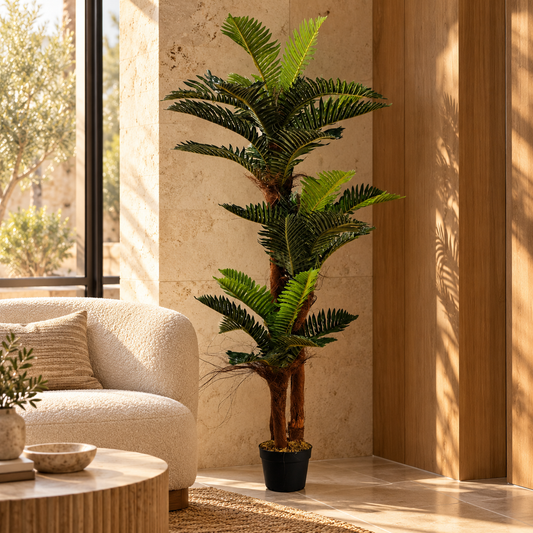
150cm Artificial Palm Tree
Regular price £67.99 GBPRegular price

The Palm guide
Choose height and movement without crowding the space.
A practical guide to palm scale, frond shape, placement, styling and care for homes and professional interiors.

How to choose an artificial palm tree
Artificial palms add height, movement and a stronger architectural silhouette. They suit larger living rooms, office breakout areas, hotel lounges and hospitality interiors where a compact tabletop plant would disappear. Start by deciding whether the room needs a narrow vertical accent or a broader canopy. Measure the floor position, ceiling height and the route used to carry the packaged product into the room.
Compare leaf shape, trunk character and canopy spread. Broad fronds make a confident statement but occupy more visual space; finer leaves create a softer edge. Natural-covered or textured trunks add realism at close range. Use supplier photography as the primary product reference and treat room scenes as placement inspiration rather than exact evidence of scale.
Palm-tree height and footprint
Mid-height palms
Palms around 100–140cm can sit beside lounge chairs, low storage and meeting-room furniture. They add a tropical note without requiring the ceiling height or floor area of a very tall specimen. Mark the nursery-pot position and the expected spread of the dressed leaves before ordering.
Tall statement palms
Palms from roughly 150–200cm work best where they can be read from across the room. Use them to soften double-height walls, define hospitality seating or bring a vertical layer to reception spaces. Keep fronds away from doors, signage, sprinklers and circulation routes. A tall tree should feel generous, not obstructive.
Artificial palms in professional interiors
In offices, palms can soften glass meeting rooms, acoustic panels and hard-edged furniture. In hospitality, a repeated palm family can connect lobby, lounge and dining areas without requiring identical sizes everywhere. For furnished rentals, use a controlled mid-height palm where its leaves will not be repeatedly compressed by curtains, doors or luggage.
Do not assume every palm is fire retardant or suitable outdoors. Those are product-level specifications. When a commercial brief requires a particular performance standard, choose only listings that explicitly confirm it and retain the product specification with the project schedule.
Styling and dressing palm leaves
Open leaves gradually after unpacking, working from the lower canopy upward. Angle fronds at slightly different heights to avoid a flat fan shape. Review the tree from its main approach and preserve enough space around the silhouette for the leaf pattern to remain legible.
Simple planters let the palm remain the focal point. Dark cylinders, warm neutral stone effects and softly textured pots work well in modern schemes. Decorative planters and surface dressings are not included unless the listing says otherwise.
Keeping an artificial palm composed
Support each leaf while dusting with a soft dry cloth. Do not pull from the tip or use aggressive polish. Recheck frond positions in busy rooms and rotate the planter only when the product remains stable. Keep indoor palms away from direct heat and outdoor exposure unless approved in the product description.
Artificial palm questions
Do palm leaves need shaping?
Yes. Products are compacted for delivery and usually need gentle dressing after unpacking.
Which palm size suits an office?
Choose from the available floor area and sightline. Mid-height forms suit meeting rooms; taller forms can anchor reception and breakout areas.
Can every artificial palm be used outdoors?
No. Only use a product outdoors when its individual listing confirms outdoor or UV-resistant suitability.