Artificial trees · Olive
Artificial olive trees for calm, considered interiors.
Explore light, branching olive silhouettes for homes, furnished rentals, offices and hospitality spaces, with verified dimensions and clear product details.
-
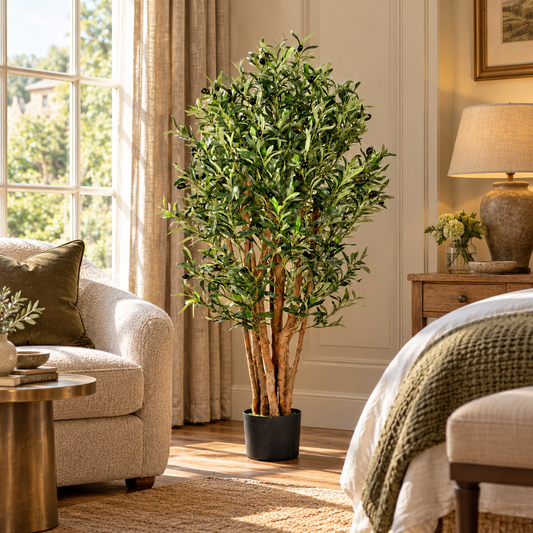
125cm Artificial Olive Tree
Regular price £117.99 GBPRegular price

The Olive guide
Choose an olive tree that feels at home in the room.
A practical guide to olive-tree form, scale, placement, styling and care for residential and professional interiors.

How to choose an artificial olive tree
Artificial olive trees bring a lighter, more open form than many dense evergreen trees. Their fine leaves, branching stems and familiar Mediterranean character work particularly well in calm residential rooms, furnished rentals, reception areas and hospitality interiors. Begin with the room rather than the product height: decide where the pot can stand, how much wall should remain visible through the branches and whether the tree will be viewed mainly from the front or from several angles.
Look closely at trunk construction and foliage density. Multi-stem olive trees can feel natural and relaxed, while a more upright single-trunk form reads as cleaner and more architectural. Some products include decorative artificial olives; these add detail but can look edible, so place them carefully in spaces used by young children. The supplier image and verified product description are the factual references for the tree supplied.
Olive foliage is designed to be dressed after unpacking. Wired stems let the canopy open into a broader silhouette, which means the final width may vary slightly with shaping. Leave space around the canopy and avoid forcing it between tall furniture. If an exact footprint is critical for a reception, corridor or repeated room scheme, contact Grove & Form before ordering.
Olive-tree size and visual scale
Compact and mid-height forms
Olive trees around 90–130cm suit sideboards, quiet living-room corners, bedrooms and smaller short-let apartments. Their open foliage keeps some background visible, helping compact rooms feel furnished without becoming crowded. Compare the tree with nearby furniture rather than selecting from height alone: a 125cm tree beside a low sofa can feel substantial, while the same tree beside tall shelving may read as a smaller accent.
Taller olive trees
Forms from roughly 140–180cm create a clearer floor-standing focal point for hotel lounges, restaurants, offices and larger homes. Check pendant lights, wall art and the path used by guests or cleaning teams. A taller tree usually looks more balanced in an outer planter with enough visual weight at floor level, but a decorative planter is only included when the individual product page explicitly says so.
Olive trees for homes, hospitality and furnished rentals
In a living room, an olive tree can soften a corner near a window, connect timber furniture with neutral textiles or add height beside a low cabinet. In a short-let, place it where it improves the principal listing photograph without blocking daylight, curtains or suitcase routes. Record the SKU, planter and room position when repeating the scheme across several properties.
Hospitality and office spaces benefit from the olive tree's lighter visual density. Use one tree beside lounge seating or repeat the same form at controlled intervals rather than mixing many unrelated plants. Keep fire routes and service paths clear. Standard indoor olive trees must remain indoors unless the individual listing specifically confirms outdoor or UV-resistant suitability.
How to style an artificial olive tree
Shape from the trunk outward, opening branches gradually and varying their direction. Preserve irregular gaps instead of creating a perfectly round canopy. Step back to the main viewing position and adjust the visible side first. Pair olive foliage with stone, warm plaster, pale timber, linen, dark metal or softly textured ceramics for a composed, material-led scheme.
The supplied nursery pot is practical and compact. An outer planter can make the tree feel integrated with the room, but check the internal opening before buying one. Stabilise the nursery pot without hiding product labels or creating loose material that is unsuitable for guest spaces.
Care and product checks
Dust leaves with a soft dry cloth, supporting delicate stems as you work. Avoid abrasive products and strong cleaning chemicals. During normal room checks, reshape compressed branches and confirm that the pot remains stable. Always follow the individual listing for construction, included components and placement restrictions.
Artificial olive tree questions
Are decorative olives edible?
No. Any artificial fruit is decorative and must not be eaten. Position fruiting styles carefully around small children.
Does the decorative planter come with the tree?
Only when the product page explicitly states that it is included. Many trees arrive in a weighted nursery pot.
Can an artificial olive tree go outside?
Only when the individual product is explicitly described as outdoor or UV resistant. Standard indoor trees should stay indoors.