Artificial trees · Topiary
Artificial topiary for structured, repeatable schemes.
Explore spiral, paired and architectural topiary forms for entrances, furnished rentals and hospitality spaces, with pack quantities stated clearly.
-
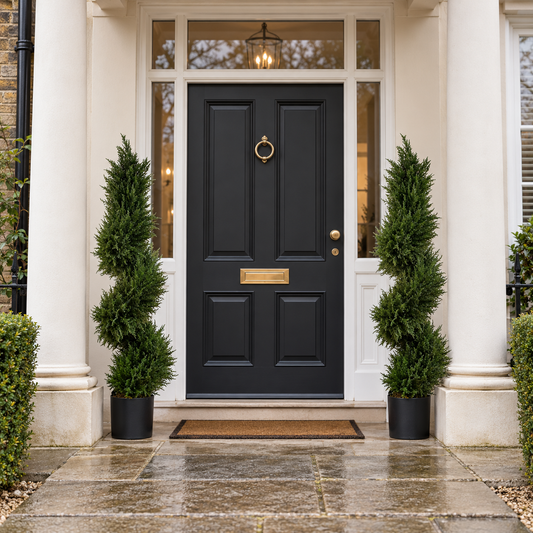
120cm Spiral Cypress Topiary Pair
Regular price £201.99 GBPRegular price

The Topiary guide
Use structured forms with clarity and balance.
A practical guide to topiary shapes, pairs, entrance placement, styling and care for residential and commercial settings.

How to choose artificial topiary
Topiary is the most structured artificial-tree family in the Grove & Form range. Spiral, ball and column forms create symmetry at entrances, repeatable rhythm in hospitality settings and a clear outline in product or property photography. Decide first whether the brief needs a single accent or a balanced pair, then confirm the pack quantity on the product page.
Shape matters as much as height. A spiral adds movement, a ball topiary feels formal and familiar, and a narrow cone or column gives vertical emphasis with a controlled footprint. Compare the overall dimensions and supplied pot. Never assume that two trees are included because two are shown in a contextual scene; the verified pack quantity is stated in the listing.
Topiary size, pairs and placement
Compact topiary
Smaller forms suit covered entrances, internal corridors, reception counters and layered displays. Allow enough empty space around a sculpted outline so the form remains clear. A compact topiary squeezed behind furniture loses the symmetry that gives it purpose.
Floor-standing pairs
Pairs around 100–140cm can frame a doorway, wide console, reception desk or hospitality threshold. Measure both sides independently; real spaces are rarely perfectly symmetrical. Check door swings, accessibility clearances and the route used by luggage, trolleys or cleaning equipment.
Topiary for entrances, hospitality and short-lets
At an entrance, topiary creates a composed first impression and photographs consistently across seasons. For a short-let, keep the forms stable and outside the primary guest route. In hospitality, repeat one silhouette rather than mixing spirals, balls and cones in the same sightline. A controlled family looks more intentional and simplifies replacement.
Outdoor suitability is not implied by the topiary shape. Some products are indoor only; others may explicitly include UV-resistant construction. Check every listing before placing a tree outside. Wind exposure, drainage and planter stability also need separate consideration.
Styling structured topiary
After unpacking, restore the outline gently without forcing branches. Work around the tree and compare both pieces when styling a pair. The two forms should feel related, but minor natural variation is more convincing than an unnaturally identical profile.
Choose outer planters with enough visual weight for the height and setting. For professional entrances, restrained stone, dark metal or textured neutral finishes keep attention on the silhouette. Confirm that the nursery pot fits the opening and remains stable.
Maintaining the topiary outline
Dust from the top downward and reshape small areas during routine checks. Avoid crushing the tree into storage or placing it where doors repeatedly brush the foliage. For paired displays, inspect both pieces together so their height, angle and planter position remain balanced.
Artificial topiary questions
Is the price for one tree or a pair?
Use the pack quantity on the individual product page. The title and description state when a set of two is supplied.
Can topiary be placed outdoors?
Only when the individual listing explicitly confirms outdoor or UV-resistant suitability.
Do spiral forms arrive ready shaped?
They retain their core form but normally need gentle dressing after transport to restore the outline.